
In today’s fast-paced business environment, organizations need a structured way to measure employee contributions, align workforce objectives with business goals, and foster continuous improvement. This is where the performance appraisal process plays a critical role. More than just an annual review exercise, it serves as a strategic framework that helps companies evaluate performance, identify development opportunities, and drive organizational success.
An effective performance appraisal process not only recognizes employee achievements but also provides meaningful feedback, enhances engagement, and creates a culture of accountability and growth.
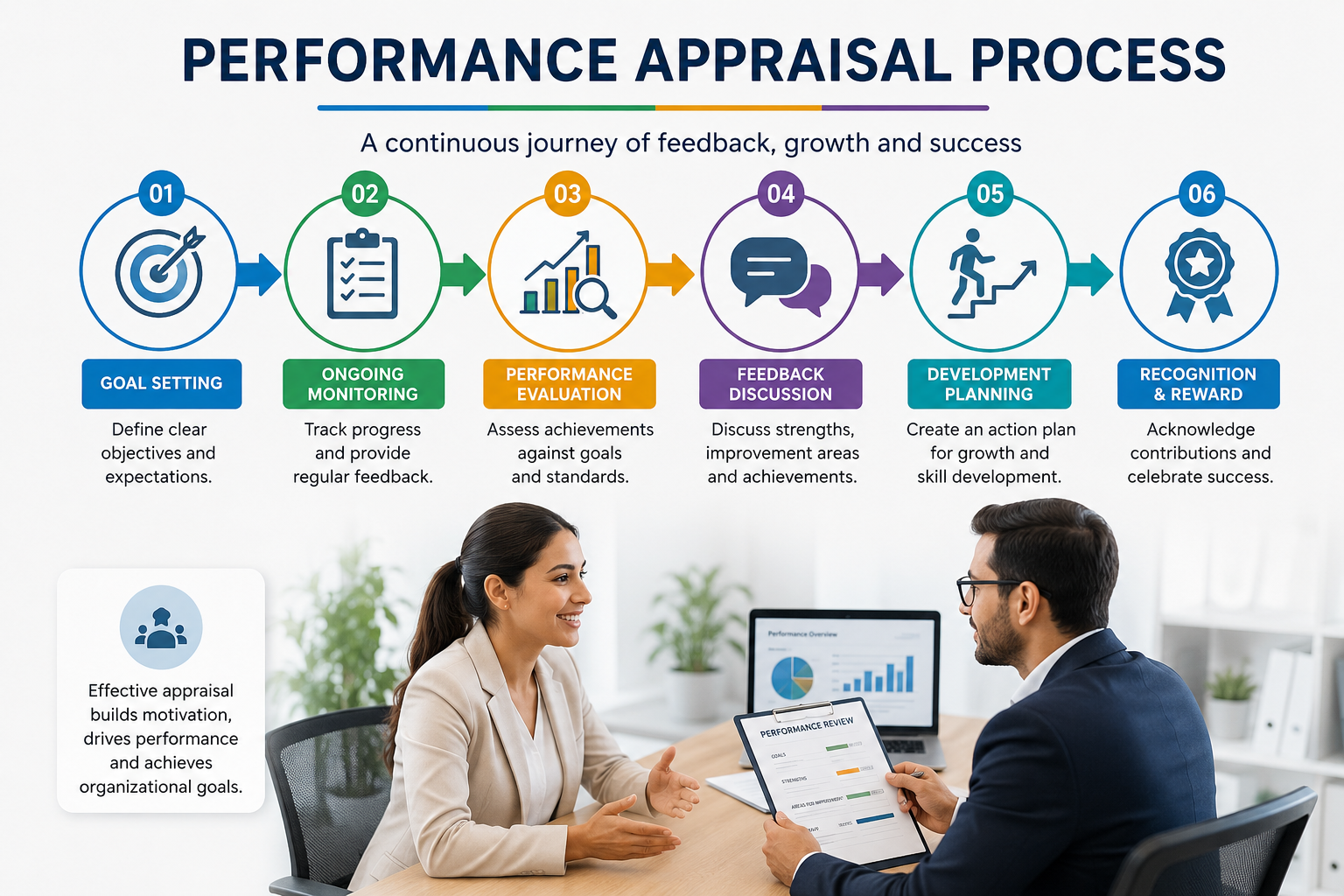
The performance appraisal process is a systematic method used by organizations to evaluate an employee’s performance during a specific review period. It involves assessing job performance, competencies, achievements, and overall contributions against predefined goals and expectations.
The process provides valuable insights that help organizations make informed decisions regarding promotions, compensation, training, succession planning, and employee development. Modern organizations increasingly use digital performance management solutions to streamline evaluations, monitor progress, and provide continuous feedback. SFT Evolve HRMS includes dedicated performance management capabilities such as goal monitoring, cyclic reviews, competency grading, and analytics to support effective evaluations.
A well-structured appraisal system benefits both organizations and employees in multiple ways.
One of the most important components of a successful performance appraisal process is the use of KRA (Key Result Areas) and KPI (Key Performance Indicators). Together, they provide a clear framework for measuring employee performance and evaluating outcomes objectively.
KRAs define the critical responsibilities and result-oriented areas where an employee is expected to perform. They establish the scope of accountability and clarify what success looks like in a specific role.
For example, the KRAs of a sales manager may include:
By defining KRAs, organizations ensure that employees focus on activities that contribute directly to business objectives.
KPIs are measurable metrics used to evaluate performance within each KRA. They provide specific benchmarks that help organizations assess whether employees are meeting expectations.
Examples of KPIs for a sales manager could include:
Incorporating KRA and KPI measurements into the performance appraisal process offers several benefits:
Modern performance management systems allow organizations to monitor KRA and KPI achievement continuously through dashboards, analytics, and automated reviews. SFT Evolve HRMS‘s performance management module supports goal monitoring, competency grading, cyclic reviews, and performance analytics, helping organizations create a structured and measurable performance framework.
A successful performance appraisal process typically consists of several important stages.
!. Goal Setting : The process begins with establishing clear objectives and expectations. Employees and managers collaboratively define goals that align with departmental and organizational priorities.
SMART goals (Specific, Measurable, Achievable, Relevant, and Time-bound) are often used to ensure clarity and accountability.
2. Continuous Performance Monitoring: Effective performance management extends beyond annual reviews. Managers should regularly monitor progress, provide guidance, and help employees overcome challenges throughout the evaluation cycle.
This ongoing approach promotes continuous improvement and prevents performance issues from escalating.
3. Performance Documentation: Maintaining accurate records of employee achievements, project outcomes, training participation, attendance, and behavioural competencies ensures that evaluations are based only on factual evidence rather than assumptions.
Thorough documentation improves fairness and consistency across the organization.
4. Self-Assessment: Many organizations encourage employees to evaluate their own performance before formal review discussions.
Self-assessments help employees reflect on accomplishments, identify challenges, and actively participate in the appraisal process.
5. Manager Evaluation
Managers review employee performance against established goals, KRAs, KPIs, competencies, and behavioral expectations.
Objective evaluations ensure that performance discussions are fact-based and constructive.
6. Feedback and Performance Discussion
The appraisal meeting provides an opportunity for managers and employees to discuss achievements, challenges, strengths, and improvement areas.
Effective feedback should be:
The goal is to encourage development while recognizing accomplishments.
7. Development Planning
Following the evaluation, organizations should create development plans tailored to individual needs. These plans may include training programs, mentoring opportunities, certification courses, and leadership development initiatives.
Development planning transforms appraisals into long-term growth opportunities.
Organizations can maximize appraisal effectiveness by adopting the following best practices:
As businesses become increasingly digital, technology is playing a vital role in enhancing the performance appraisal process.
Modern HRMS platforms can help organizations:
Integrated performance management systems reduce administrative workload while providing greater visibility into employee performance. Solutions like SFT Evolve HRMS bring together goal management, competency evaluation, analytics, and review workflows within a centralized HR platform, helping organizations build a more transparent and high-performing workforce.
A well-designed performance appraisal process is essential for building a productive, engaged, and high-performing workforce. By combining continuous feedback, structured evaluations, clearly defined KRAs, measurable KPIs, and employee development initiatives, organizations can create a culture of accountability and continuous improvement.
As businesses continue to evolve, leveraging modern performance management technology can significantly enhance the effectiveness and accuracy of appraisals, ensuring that both employees and organizations achieve their full potential.
Take your performance appraisal process to the next level with SFT Evolve HRMS. Book a demo today at https://sftevolve.com/ and discover how SFT Evolve HRMS can simplify your performance appraisal process while driving employee engagement and business success.